Build trusted, relationship-aware customer data across stores, ecommerce, loyalty, service, Data 360 and Agentforce.
Retail customer data is created everywhere: in store, online, through clienteling apps, contact centres, loyalty programmes, ecommerce platforms, marketing journeys and point-of-sale systems.
For many retailers, Salesforce becomes the place where this customer data needs to be trusted and used. But creating a reliable customer view is difficult when customer records are duplicated, fragmented across brands or markets, governed by different consent rules or shaped by complex source-system relationships.
clearMDM helps retailers build a trusted customer data foundation directly inside Salesforce CRM. It goes beyond deduplication to support Golden Records, survivorship, consent-aware merge rules, stewardship, governance and real-world customer relationships.
Why retail customer data is difficult
Retail customer data is rarely simple.
A single customer may shop in multiple countries, buy across different brands, register in a boutique through a clienteling app, contact customer care, join a loyalty programme, interact with marketing campaigns and purchase through ecommerce or store channels.
That creates practical data-quality challenges:
- Duplicate B2C Person Accounts or Contact Profiles across markets, brands and systems.
- Conflicting customer attributes from POS, ecommerce, loyalty and service platforms.
- Different consent requirements and indicators by market, brand or channel.
- Complex survivorship logic to govern where records should be merged, mastered, linked or kept separate.
- Store associates and customer-care teams that need a trusted customer view in real time (not the next hour or following day).
- Data 360 and marketing journeys that depend on clean, accurate and governed customer data, for example avoiding welcome journeys for returning customers.
- Agentforce and AI use cases that need trusted customer context before recommending or taking action.
Retail data-quality problems are not limited to obvious duplicates. Guest checkout profiles may later become registered customers. Store-created records may conflict with ecommerce profiles. Loyalty, service, returns and clienteling systems may all hold different identifiers for the same person. Consent, VIP status, loyalty tier, preferred store and household relationships may also vary by brand, market or channel.
Not every customer profile should be handled in the same way. High-volume ecommerce records may need to be processed automatically with minimal friction, while high-value customers, VIPs, personal-shopper clients or customers with sensitive relationship context may require additional safeguards, review logic or stewardship.
For retail organisations, Customer 360 is not just a data model. It is an operating model for deciding which customer data should be trusted, how it should be governed and how it should be maintained as customer relationships change.
Salesforce-native Operational MDM for retail
clearMDM is a Salesforce-native Operational MDM platform. It helps retailers govern trusted customer data where operational work happens: inside Salesforce CRM.
With clearMDM, retailers can support:
- Real-time or batch Cleanse > Match > Merge > Govern > Maintain data flows.
- Golden Records using standard Salesforce objects such as B2C Person Accounts, Accounts and Contacts or Custom Objects.
- Consent-aware merge and survivorship rules.
- Market-specific and brand-specific governance, data partitioning and Golden Records.
- Stewardship workflows for complex or ambiguous matches.
- Relationship-aware customer data for households, families, colleagues, customer contacts, buying groups and other real-world retail relationships.
- Trusted customer data for Customer 360, Data 360, Agentforce and AI-driven activation.
Rather than treating data quality as a one-off deduplication exercise, clearMDM helps retailers continuously govern and maintain trusted customer data over time.
Supporting Customer 360 across retail channels
Retailers need more than a clean customer record. They need a trusted customer view that can support customer care, in-store experiences such as clienteling, service, marketing, loyalty and analytics.
clearMDM can help retailers answer questions such as:
- Which customer record should be treated as the master?
- Which email address, phone number or address should survive over time?
- Which consent value takes precedence?
- Which brand, market or source system owns the customer relationship?
- Should two records be merged, linked, mastered, suppressed or kept separate?
- Which customer profile should be used by service teams, clienteling apps or marketing journeys?
- Which real-world customer relationships need to be maintained?
- Which data is safe for Agentforce or AI-powered processes to use?
These are not simply deduplication questions. They are governance questions.
How clearMDM fits into a retail Salesforce architecture
A typical retail architecture may include ecommerce, POS, order management, loyalty, marketing, service, consent, identity, clienteling, returns, appointment booking, mobile app, data warehouse and after-sales service systems. Customer data may flow into Salesforce CRM through APIs, middleware, batch processes, streaming events or platform events.
clearMDM provides the trust layer inside Salesforce CRM.
A common pattern is:
Retail source systems
POS, ecommerce, loyalty, service, marketing, consent, identity and order systems.
Integration layer
Middleware, APIs, platform events, batch feeds and real-time updates.
Salesforce CRM (Customer 360) + clearMDM
Operational customer processes, Golden Records, survivorship, stewardship, consent-aware merge rules and trusted customer data.
Data 360
Harmonisation, identity resolution, unified profiles, insights, segmentation and activation.
Activation and intelligence
Personalised journeys, clienteling, customer care, marketing, analytics, Agentforce and AI.
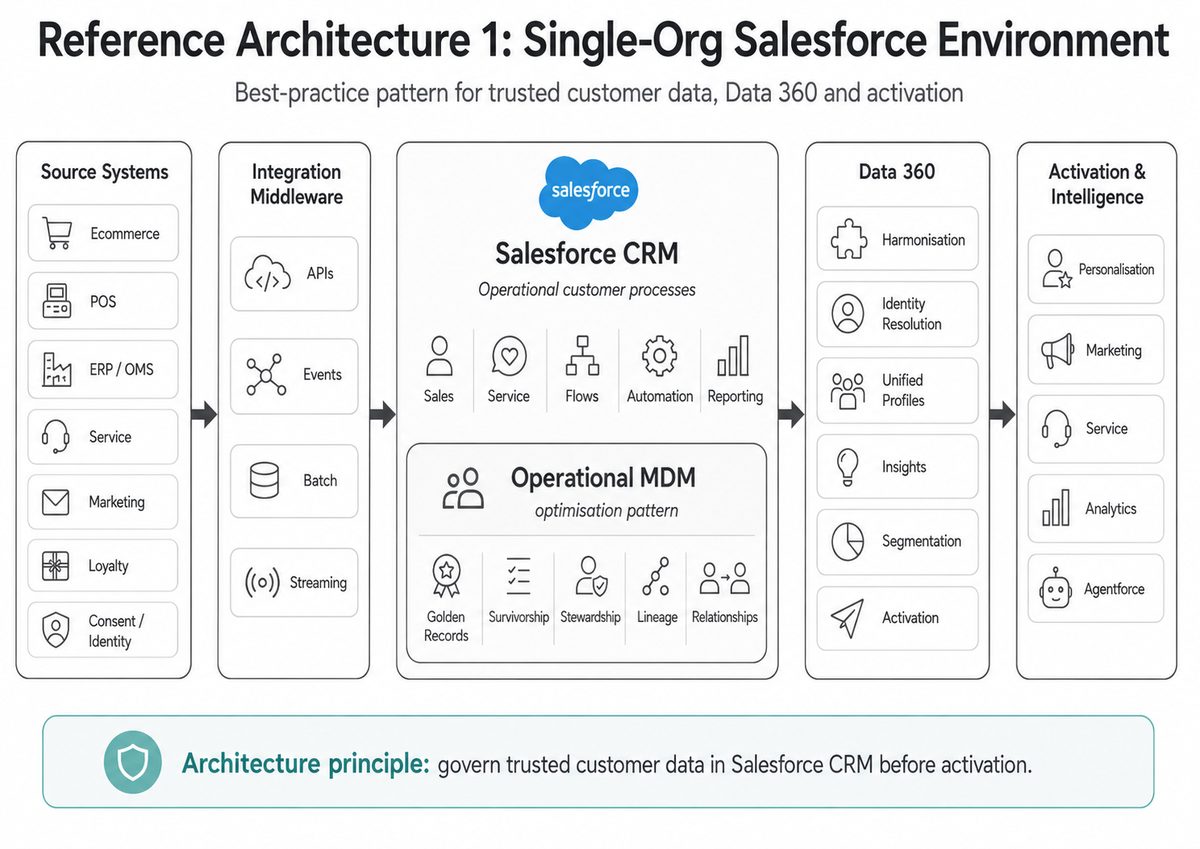
Retail reference architecture: clearMDM governs trusted customer data inside Salesforce CRM before it is harmonised, segmented or activated through Data 360 and Agentforce.
In this model, clearMDM complements Data 360. clearMDM improves the quality, consistency and trustworthiness of operational CRM data before it is harmonised, segmented or activated. Data 360 then uses that stronger foundation for broader unification, insight and activation.
For multi-brand and multi-market retailers
Many retailers operate across multiple brands, regions, markets or Salesforce orgs. This is common in global retail, fashion and apparel, beauty and fragrance, home furnishing, jewellery, consumer goods and franchise-style operating models.
In these environments, customer data governance becomes more complex because each market may have its own source systems, consent rules, customer identifiers, operating model and Salesforce processes.
A customer might interact with one brand in store, another brand online, a service team in a different country and a loyalty programme managed through a separate platform. Those interactions may all be relevant to Customer 360, but they cannot always be merged or activated in the same way.
In some retail models, a single enterprise-wide Golden Record is not always appropriate. Retailers may need brand-level or market-level Golden Records so that customer data can be governed within the right commercial, consent and operating boundaries.
clearMDM can support multi-brand and multi-market retail architectures by helping teams govern trusted customer data close to the operational Salesforce org, while still supporting broader unification and activation through Data 360.
This is especially important where retailers need to manage:
- Market-specific consent rules.
- Brand-specific merge restrictions.
- Regional data-governance policies.
- Multiple Salesforce orgs.
- Separate clienteling, POS, loyalty, OMS or ecommerce platforms.
- Shared Data 360 activation models.
- Real-world relationships across households, customers, accounts and contacts.
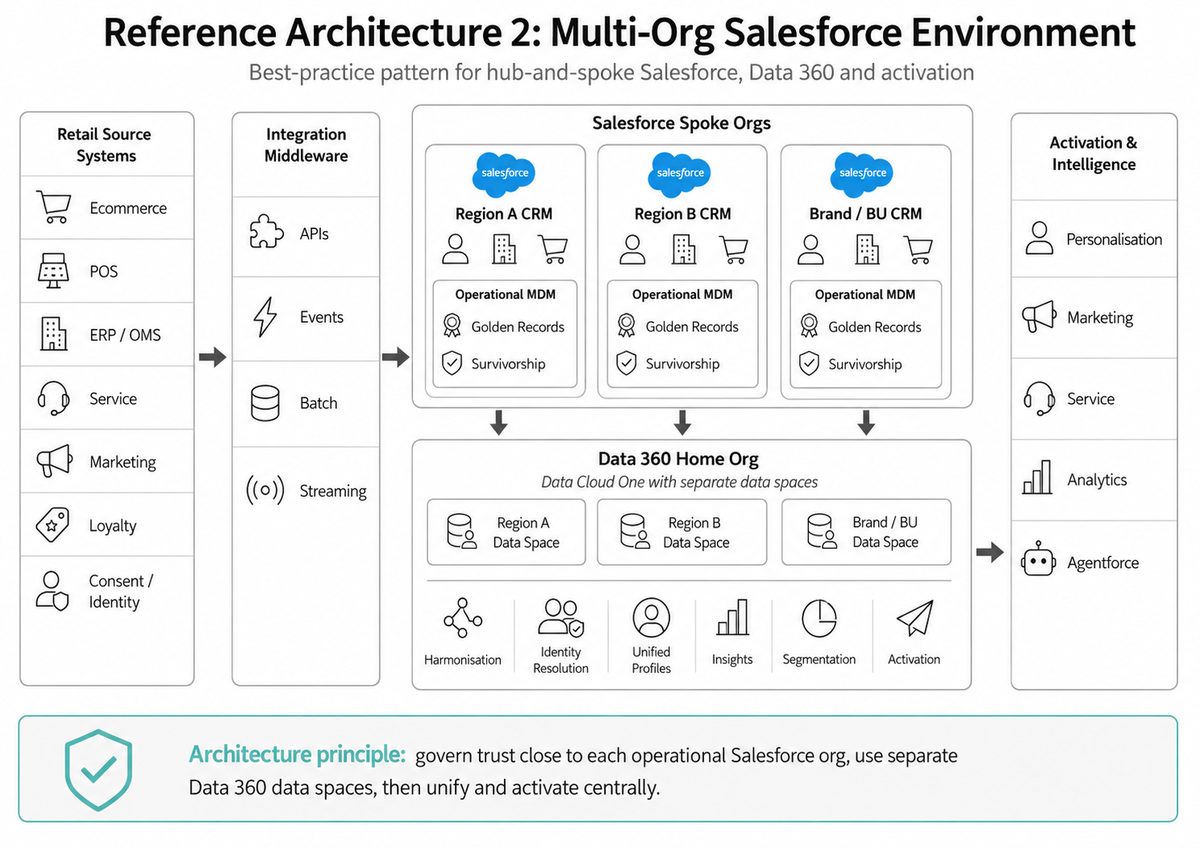
Multi-org retail architecture: clearMDM can support trusted customer data governance across regional or brand Salesforce orgs, while Data 360 provides a broader unification and activation layer.
The goal is not to force every market or brand into the same operational model. The goal is to create a governed architecture where trusted customer data can be managed locally, then unified and activated centrally where appropriate.
Anonymised retail customer profiles
The following anonymised customer profiles are based on real-world clearMDM retail implementations. They show how global retailers have used Salesforce-native Operational MDM to address complex customer data-quality challenges across markets, brands, consent rules, source systems and customer journeys.
clearMDM is used across retail businesses that blend high-volume ecommerce with high-touch store experiences, including airport boutiques, fashion and apparel brands, beauty and fragrance retailers, furniture and home furnishing retailers, watch and jewellery retailers and other specialty retail organisations.
These environments often combine large-scale digital customer acquisition with relationship-led retail experiences, where trusted customer data matters for clienteling, customer care, loyalty, consent management, personalised marketing and Data 360 activation.
Customer profile 1: APAC retail group
Challenge
An APAC retail group needed a Single Customer View to support customer care, clienteling and personalised marketing journeys across multiple markets. The customer data model also needed to support the Salesforce Consent Management Data Model. A real-time data cleansing process was also required with customer data verification and enrichment.
Environment
The organisation operated across several retail divisions, including apparel and beauty products, with customer data managed across multiple APAC markets.
The Salesforce environment included millions of B2C Person Accounts and contact profiles. Transactions and aggregations were implemented on the Heroku platform, while Salesforce CRM remained central to the operational customer view.
Architecture
clearMDM supported a real-time Cleanse > Match > Merge > Govern > Maintain data flow, with B2C Person Accounts acting as the master records. A staging object data model was used to support complex processing requirements before trusted customer data was promoted into the customer master (B2C Person Accounts).
Integrations
The implementation included POS integration through BizTalk, Platform Events to communicate Single Customer View updates and clienteling iPad app customer registration using the clearMDM Quick Lookup API. Real-time cleansing and enrichment was implemented using a 3rd party global data provider (with regional coverage) for Name, Address, Phone and Email field groupings.
Governance complexity
The solution needed to support complex merge rules across market variations and consent requirements. This was particularly important where customer data could not simply be merged based on matching identifiers alone.
Outcome
The retailer established a governed Single Customer View that could support customer care, clienteling and personalised marketing journeys across a large, multi-market APAC retail environment.
Customer profile 2: European luxury fashion retail group
Challenge
A European luxury fashion retail group needed a Single Customer View to support customer care, clienteling, personalised marketing journeys, Service Cloud Voice and Live Chat.
A key requirement was flexibility. High-volume ecommerce customers needed to be processed in a low-friction, automated way, while high-value or key customers needed more careful handling based on indicators such as honorifics, personal shopper relationships or other VIP customer signals.
Environment
The organisation operated across several luxury retail divisions, including fashion and jewellery, with customer data managed across multiple markets in Europe and the Americas.
The Salesforce environment included millions of B2C Person Accounts and their associated transactions.
Architecture
clearMDM implemented a hybrid batch and real-time processing model using a standard object data model. In this architecture, B2C Person Accounts acted as both master and source records.
Integrations
The customer data landscape included Salesforce Marketing Cloud Engagement, multiple retail systems including SAP Hybris and other retail POS, ecommerce platforms and a Heroku-based clienteling app.
Governance complexity
The architecture needed to handle complex merge rules across source-system variation, consent requirements and customer value indicators. This was especially important because different systems contributed different customer attributes and not every matching record could be treated in the same way.
The solution needed to distinguish between high-volume ecommerce records that could be processed with minimal friction and high-value customer records that required additional safeguards, review logic or stewardship.
Outcome
The retailer established a governed customer data foundation to support service, clienteling and personalised marketing use cases, while helping teams manage customer data consistently across multiple markets, systems and customer segments.
Customer profile 3: Global beauty and cosmetics retail group
Challenge
A global cosmetics group needed a master system of record for prospect and customer records, with a 360-degree view of the customer. The requirement included automatic cleansing, enrichment, verification and deduplication, while minimising impact on the existing data architecture.
A key challenge was the need to ring-fence customer data at brand level. Rather than creating a single cross-brand customer master, the retailer needed brand-specific Golden Records so that each brand could maintain appropriate control over its own customer relationships, consent rules and activation strategy.
Loyalty was also a major requirement. The customer data foundation needed to support loyalty programme integration, customer recognition and trusted customer profiles across retail, ecommerce and engagement channels.
Environment
The organisation operated across Europe, the Americas and APAC, with double-digit millions of B2C Person Accounts, transactions and aggregates.
Architecture
clearMDM implemented a real-time Cleanse > Match > Merge > Govern > Maintain data flow and helped enforce strict data-governance rules across brands and markets.
The architecture supported brand-specific Golden Records, allowing customer data to be governed within the appropriate brand boundary rather than merged into a single cross-brand master where this was not permitted or appropriate.
Integrations
The retail technology landscape included Salesforce Commerce Cloud, formerly Demandware, multiple retail POS and a Salesforce native loyalty programme integration.
Governance complexity
The solution had to support GDPR requirements, consent to merge and process and strict no cross-brand merge rules. This meant that matching logic alone was not enough. The MDM process needed to understand brand variance, consent constraints, loyalty context and governance policies before records could be merged, mastered or kept separate.
Outcome
The retailer established a Salesforce-native data-quality and Operational MDM approach that supported trusted, brand-specific customer Golden Records while respecting strict governance, consent and no cross-brand merge requirements.
The solution also provided a stronger customer data foundation for loyalty, ecommerce, POS and customer engagement use cases across regions.
Why consent-aware customer data matters in retail
Retail customer data is highly sensitive because it is often used for personalisation, marketing, loyalty, direct customer experiences such as clienteling and service.
That makes consent management central to customer data quality.
A customer may consent to marketing in one market, one brand or one channel, but not another. They may have multiple profiles created through ecommerce, POS, loyalty or service interactions. They may also have different processing permissions depending on region, brand or source system.
For this reason, retail MDM cannot rely on simple duplicate matching alone.
Retailers need rules that determine:
- Whether records can be merged.
- Which consent value should survive.
- Whether records should be linked but not merged.
- Which brand or market owns the relationship.
- Which profile should be used for marketing, service or clienteling.
- Which data can be activated through Data 360 or AI.
clearMDM supports these more advanced governance patterns by helping retailers manage trusted customer data directly inside Salesforce.
Operational MDM and Data 360 for retail
Data 360 can help retailers unify and activate customer data across Salesforce and wider enterprise systems. It can support segmentation, insights, analytics, journeys and AI-powered experiences.
But Data 360 still depends on trusted source data.
If operational CRM data contains duplicate customers, conflicting attributes, unclear consent or weak survivorship rules, those issues can flow downstream into segmentation, analytics and activation.
Operational MDM improves the quality of the source data before it is used more broadly.
In a retail architecture:
- clearMDM governs trusted customer data in Salesforce CRM.
- Data 360 harmonises, unifies and activates customer data across the broader ecosystem.
- Agentforce and AI use governed customer context to support more reliable recommendations and actions.
The strongest retail Customer 360 architectures use both.
Business benefits for retail teams
Trusted customer data improves the experiences that matter most in retail.
For clienteling teams, store associates and client advisors can work from a more trusted view of the customer, including contact details, preferences, purchase history, consent, loyalty status and real-world relationship context.
For customer-care teams, agents can resolve issues with greater confidence because customer records, service history, orders, returns and preferences are linked to the right customer profile.
For marketing teams, cleaner customer data supports more accurate segmentation, fewer duplicate communications, better consent handling and more relevant personalised journeys.
For loyalty teams, trusted customer data helps maintain more accurate loyalty tier, VIP status, preferences and customer recognition across channels and markets.
For data and analytics teams, governed customer data improves reporting confidence and provides a stronger foundation for Data 360, dashboards and customer insight.
For AI and Agentforce, trusted customer context helps support safer recommendations, better automation and more reliable assisted decision-making.
Build trusted retail customer data with clearMDM
Retailers do not need another one-off deduplication project. They need a governed customer data foundation that can support Customer 360, Data 360, Agentforce and personalised retail experiences.
clearMDM helps retailers move beyond duplicate management to build trusted, governed and relationship-aware customer data directly inside Salesforce CRM.
With clearMDM, retailers can support complex retail data-quality requirements across markets, brands, consent rules, source systems and customer journeys.
Ready to build trusted retail customer data in Salesforce?
See how clearMDM helps retailers create trusted customer data foundations for Customer 360, Data 360 and Agentforce.
Book a retail data quality consultation