Author: Mark Cane (Salesforce CTA since 2012). Last updated: 29th April 2026
In the emerging AI-era, data quality and governance (generally) and customer data unification (specifically) should be foundational elements of every AI strategy irrespective of platform or industry. In the Salesforce CRM context, enterprises are faced with resolving sometimes long-standing, difficult data quality challenges that have been deferred due to cost, or the possibility of manual or process workarounds. In the AI-era those workarounds don’t easily apply and a root cause resolution is necessary to unlock the potential of the generative AI and agentic AI (Agentforce) capabilities offered by the Salesforce platform.
Salesforce provides native capabilities for duplicate prevention through the features referred to collectively as Duplicate Management. In many cases these basic controls are insufficient and 3rd-party deduplication tools, sourced from the Salesforce AppExchange, are implemented to improve duplicate detection and to automate duplicate resolution.
However, both approaches are primarily focused on duplicate resolution as a one-time fix rather than the continuous management of trusted data across a lifecycle. This is where operational MDM, delivered natively within Salesforce CRM, represents a different approach.
The Distinction
Deduplication tools improve how duplicates are resolved. Operational MDM changes how data is managed. The diagram below provides an overview of the key points of distinction.
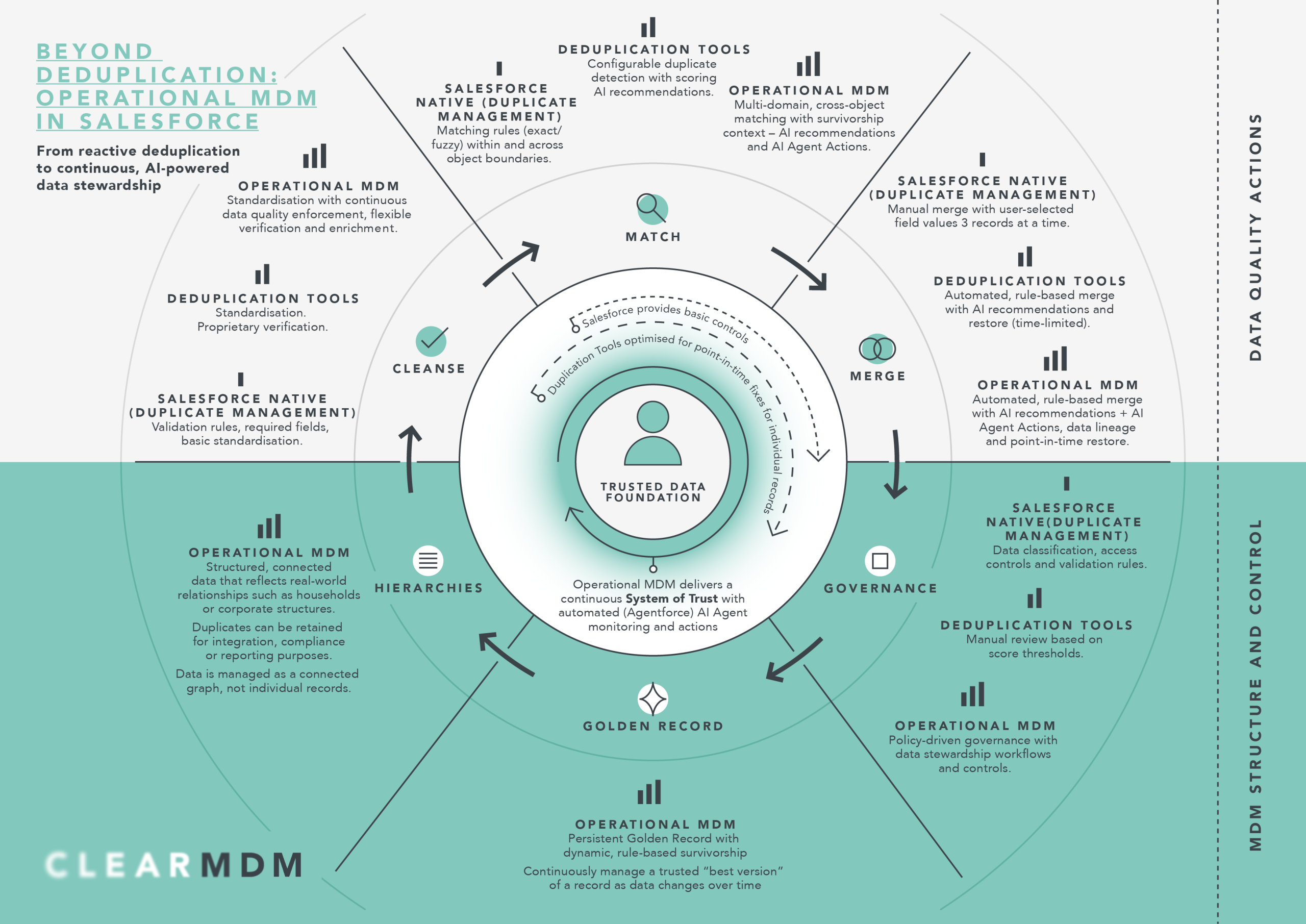
Operational MDM vs. Salesforce Deduplication Tools: A Side-by-Side Comparison
The table below provides an at-a-glance comparison of the three Salesforce data management strategies.
| Criteria | Salesforce Native (Duplicate Management) | Salesforce Deduplication Tools | Operational MDM |
|---|---|---|---|
| Primary purpose | Point-of-entry duplicate protection in small scale orgs. | Duplicate detection and automated resolution at scale and bulk clean-ups. | Continuous management of trusted data across a lifecycle. |
| Cleanse | Validation rules, required fields, basic standardisation. | Data standardisation. Proprietary verification for common entities such as Address and Email. | Data standardisation with continuous data quality enforcement. Flexible verification and enrichment of data via 3rd party data providers. |
| Match | Matching rules (exact/fuzzy) within and across object boundaries. | Configurable duplicate detection with advanced matching logic and scoring. | Multi-domain, cross-object matching with survivorship context. |
| Merge | Manual in groups of 3 records. | Automated, rule-based merge with rollback/restore (time-limited). | Automated, rule-based merge with rollback/restore (no time limit). Full data lineage and audit controls at field level. |
| Data governance | Data classification, access controls and validation rules. | Manual review based on score thresholds. | Policy-driven governance with data stewardship workflows and controls. |
| Golden record | Not applicable. | Not applicable. | Persistent Golden Record with dynamic, rule-based survivorship. Continuously manage a trusted “best version” of a record as data changes over time. |
| Hierarchies | Not applicable. | Not applicable. | Structured, connected data that reflects real-world relationships such as households or corporate structures. Duplicates can be retained for integration, compliance or reporting purposes. Data is managed as a connected graph, not individual records. |
| Operational Model | Reactive (at the point-of-entry). | Reactive and Periodic (scheduled bulk actions). | Reactive and Periodic and Continuous (always-on data management actions). |
| AI capability | None. | Proprietary. AI Match and Merge recommendations. | Agentforce Data Steward Agent. Data Quality, Data Governance and AI Data Stewardship. |
In Summary: Salesforce Data Strategy Guidance
Salesforce Native Duplicate Management features are optimal when:
- Your primary requirement is duplicate prevention.
- Your data volumes are low-to-medium and the Salesforce org has a low complexity configuration.
- You are getting started on improving your Salesforce data quality and are looking for a quick-win or option.
Salesforce Deduplication Tools are optimal when:
- You require greater accuracy or flexibility than the native controls provide.
- You require workflow automation and bulk processing capabilities.
- Your data governance needs are satisfied by score-based thresholds and manual reviews.
Operational MDM is optimal when:
- Your primary requirement is to manage trusted data (Golden records) across a lifecycle.
- You want to manage data as a hierarchy of related (or connected) records (optionally with duplicates retained but hidden from business users).
- Your data governance requirements are medium-to-complex.
- You wish to manage scale and accuracy through automated AI Agent monitoring and AI data stewardship.
Finally
The data management strategies described above are not mutually exclusive, but instead reflect a progression in data management maturity.
Organisations may start with Salesforce native features for duplicate prevention, then extend with Salesforce Deduplication tools to improve accuracy and automation and finally adopt Operational MDM as data complexity and governance requirements increase. It may also be the case that Operational MDM, as a superset of capabilities, represents the optimal starting point; in addition to the complexity of the data management requirements aspect, this is also true where Agentforce or Data 360 are part of the Salesforce architecture.