Last updated: 1st August 2026
A Golden Record establishes governed operational truth. A Unified Profile expands customer context for insight and activation. The strongest Customer 360 architecture takes advantage of both.
Golden Records and Unified Profiles are often discussed as competing ways to create a single customer view (SCV). This isn’t the case, both bring customer data together, but they answer different questions and serve different parts of the Salesforce architecture.
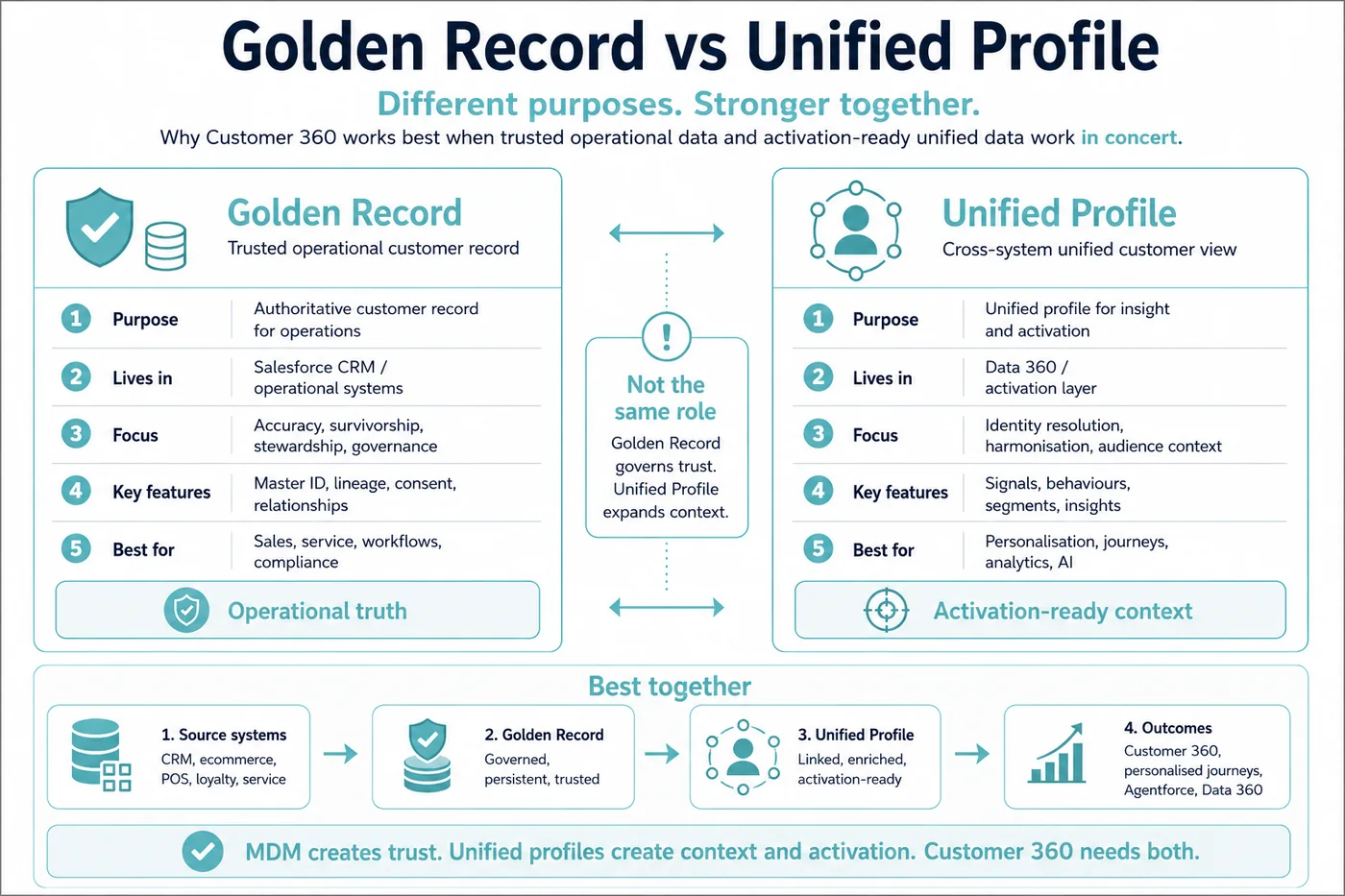
Golden Records and Unified Profiles serve different architectural purposes. The Golden Record governs operational truth, while the Unified Profile expands customer context for insight and activation.
A Golden Record answers: Which customer data should our operational users, processes and systems trust?
A Unified Profile answers: What wider customer data and context can we bring together for insight, segmentation, personalisation and activation?
Salesforce makes this distinction explicitly. Data 360 identity resolution generates Unified Profiles from source profile data, but Salesforce describes those profiles as a system of reference rather than Golden Records. Identity resolution links source profiles without replacing the underlying source data.
The choice is therefore more nuanced than Golden Record or Unified Profile. For organisations building Customer 360, Data 360 and Agentforce capabilities, the strongest architecture normally needs both.
The Difference in One Sentence
A Golden Record creates governed operational truth. A Unified Profile creates activation-ready customer context.
The Golden Record provides a persistent and governed version of the customer for operational use. The Unified Profile connects that trusted customer identity to a broader set of transactional, behavioural, engagement and channel data.
One establishes what should be trusted. The other expands what can be understood and acted upon.
What Is a Golden Record?
A Golden Record is the governed operational version of a customer, account, product or other master-data entity.
It is created by applying data quality, matching, survivorship and governance rules to customer data from one or more source systems. Its purpose is not simply to join records together. It is to determine how trusted customer data should be maintained as those records change over time.
A well-designed Golden Record can provide:
- A persistent master identifier.
- Attribute-level source ownership.
- Survivorship rules.
- Data stewardship and exception handling.
- Consent-aware governance.
- Data lineage and auditability.
- Customer relationships and hierarchies.
- Ongoing lifecycle management.
In Salesforce CRM, the Golden Record becomes the trusted customer record used by sales, service, Flow automation, Apex logic, operational reporting and downstream integrations. A high-value operational data asset.
It does not have to represent one simplistic value for every possible attribute. A customer can have several valid addresses, email addresses, phone numbers, preferences or relationships. Operational MDM determines how those values should be governed, which should be promoted for a given purpose, and which should remain available as source or historical context.
For example:
- ERP may own the billing address.
- Service Cloud may own support preferences.
- A consent platform may own processing permissions.
- A loyalty platform may own membership status.
- Salesforce CRM may own the active customer relationship.
- Several email addresses may remain valid, with one promoted for a particular operational use.
The objective is not to flatten the customer into a single database row at any cost. It is to create a governed and explainable operating model for trusted customer data.
What Is a Unified Profile?
A Unified Profile in Salesforce Data 360, formerly Data Cloud, is created through identity resolution.
Identity resolution uses matching rules to determine which source profiles relate to the same person (individual) or account (business). Data 360 then provides a Unified Profile through which the organisation can access the underlying source records, contact points and wider customer context.
Salesforce describes this through a “key ring” analogy: the Unified Profile connects the organisation to the relevant source records without necessarily merging those records or overwriting their values. It can therefore support different views of the customer for different use cases.
A Unified Profile is particularly valuable for bringing together:
- CRM customer data.
- Ecommerce activity.
- POS transactions.
- Loyalty interactions.
- Marketing engagement.
- Web and mobile behaviour.
- Service interactions.
- External data-platform records.
- Calculated insights.
- Audience and segment membership.
Data 360 also supports reconciliation rules that influence how data is selected for presentation within Unified Profile outputs. These rules do not need to overwrite the original source records.
The result is a richer, activation-ready customer view that can support segmentation, personalised journeys, analytics, sales and service enrichment, and AI-powered experiences.
Golden Record vs Unified Profile: Key Differences
| Dimension | Golden Record | Unified Profile |
|---|---|---|
| Primary purpose | Establish trusted operational customer data | Assemble customer context for insight and activation |
| Core question | Which data should users and processes trust? | Which records and signals relate to this customer? |
| Typical location | Salesforce CRM or another operational MDM environment | Salesforce Data 360 |
| Data scope | Governed customer attributes, identifiers, consent and relationships | CRM, transactional, behavioural, engagement and channel data |
| Identity approach | Operational matching, mastering and lifecycle governance | Cross-source identity resolution and profile unification |
| Attribute handling | Source ownership and context-aware survivorship | Retains source values and can apply reconciliation rules for specific views |
| Identifier | Persistent operational master ID | Unified Profile ID generated by identity resolution |
| Governance | Stewardship, lineage, audit, policy and exception handling | Identity rules, reconciliation rules, data access and activation governance |
| Relationships | Operational relationships and hierarchies | Broader linked profile and engagement context |
| Best suited to | Sales, service, workflows, reporting, compliance and operational AI | Segmentation, personalisation, analytics, journeys and cross-channel activation |
A Data 360 Unified Profile ID can change when profiles are joined or split following changes to identity-resolution data or rules. That is appropriate for a dynamically resolved profile, but it also illustrates why a Unified Profile ID should not automatically be treated as a permanent enterprise master identifier.
Why Golden Records and Unified Profiles Work Better in Concert
Consider a customer whose data exists across Salesforce CRM, ecommerce, POS, loyalty, service and marketing platforms.
Data 360 may determine that the following records relate to the same person:
- Jane Smith in Salesforce CRM.
- J. Smith in a support platform.
- jane.smith@email.com in Marketing Cloud.
- A loyalty member with a separate customer number.
- An ecommerce shopper identified through a device or cookie.
- A POS customer profile created in store.
That is valuable identity resolution. But the business still needs to answer operational questions:
- Which email address should sales and service use?
- Which phone number is current?
- Which consent indicator takes precedence?
- Which loyalty ID is authoritative?
- Which account or household relationship is active?
- Should two CRM records be merged, linked, retained or suppressed?
- Who reviews an ambiguous match?
- Which identifier should downstream operational systems retain?
The Golden Record answers those questions through governance, survivorship, stewardship and source ownership.
The Unified Profile can then link that trusted operational identity with wider transactional, behavioural and engagement signals. Data 360 supports unification based on external links and identifiers, including identifiers created in an external MDM system. This means a governed master ID can provide a useful anchor for broader profile unification.
The architecture becomes:
Source systems and channels
↓
Operational MDM and Golden Record
↓
Data 360 Unified Profile and wider customer context
↓
Customer 360, personalisation, analytics and Agentforce
This should not be interpreted as meaning every source must pass through MDM before reaching Data 360. Behavioural, event and high-volume engagement data may flow directly into Data 360.
The Golden Record provides the governed operational anchor. The Unified Profile connects that anchor to the broader customer ecosystem.
Common Misnomers About Golden Records and Unified Profiles
Misnomer 1: A Golden Record must select one “best” value for every attribute
A poorly designed Golden Record may attempt to force every field into a single universal value. A mature MDM implementation should use attribute-level and context-aware survivorship.
There may be no universally “best” address, but there may be:
- A trusted billing address.
- A preferred delivery address.
- A current residential address.
- A historical address.
- An address supplied by a particular source.
Similarly, a customer may legitimately have several email addresses, phone numbers, consent records or organisational relationships. The role of Operational MDM is to govern those values, not arbitrarily discard useful context.
Misnomer 2: A Golden Record is an oversimplified customer view
A Golden Record becomes oversimplified only when the underlying data model is oversimplified. A well-designed Golden Record can include:
- Multiple governed contact points.
- Attribute history.
- Source-record associations.
- Consent and preference records.
- Relationships and hierarchies.
- Brand-level or market-level mastering.
- Effective dates and lifecycle status.
The Golden Record does not need to contain every customer interaction. That is where the Unified Profile adds value. But it can still provide a rich and relationship-aware operational view.
Misnomer 3: Stakeholder agreement makes Golden Records impractical
Agreeing source ownership, survivorship and governance policies does require business participation. That is not a weakness of MDM. It is the governance work required to establish trustworthy operational data. Without those decisions, the ambiguity still exists; it is simply pushed downstream into reporting, integration logic, manual workarounds, Data 360 activation or AI outputs.
However, this does not mean that every stakeholder across the enterprise must agree to one universal set of rules.
A mature Operational MDM model can apply governance flexibly within the appropriate business boundary. Matching, survivorship, merge and stewardship rules may be defined at enterprise, business-unit, brand, market, region, legal-entity, channel or data-domain level. Rules can also vary by customer attribute or source system.
For example:
- One market may apply different consent-survivorship rules from another.
- Separate brands may maintain their own Golden Records and prohibit cross-brand merges.
- A business unit may trust a particular source for billing data while another uses a different operational system.
- High-volume ecommerce records may follow a largely automated process, while high-value or sensitive customer records are escalated for stewardship.
Enterprise-wide governance principles can therefore coexist with local operating requirements. The objective is not universal agreement on every rule. It is clear ownership, explicit policy and consistent decision-making within the relevant governance boundary. Once those policies are defined, many survivorship and stewardship decisions can be automated, with only ambiguous, sensitive or high-risk cases escalated for human review.
Misnomer 4: Golden Records overwrite source data and destroy lineage
This describes a destructive implementation pattern, not a requirement of MDM. Modern Operational MDM can preserve:
- Original source records.
- Source identifiers.
- Field-level lineage.
- Merge and survivorship history.
- Audit trails.
- Point-in-time restore or rollback capabilities.
- Source-to-master relationships.
A Golden Record can be maintained separately from source records, or source records can be retained within a governed hierarchy. Overwriting values without preserving lineage is an anti-pattern.
Misnomer 5: Unified Profiles never select preferred values
Data 360 does not need to overwrite source data or establish a permanent operational winner. That distinction is important.
However, Data 360 does support reconciliation rules that determine how data is selected within Unified Profile outputs for particular use cases. For example, Salesforce documentation illustrates reconciliation using rules such as “Most Frequent”.
The distinction is therefore not simply: Golden Record selects values; Unified Profile does not.
It is: A Golden Record governs trusted operational values and ownership over time. A Unified Profile retains source context and can reconcile data for insight and activation without replacing the operational source records.
Misnomer 6: Both approaches consolidate records into the same kind of record
The word “consolidate” can obscure an important difference. A Unified Profile logically links source profiles through identity resolution. The source records remain independently available. A Golden Record operationally masters the customer. It may promote trusted values, assign a persistent master ID, govern relationships and control how users and processes interact with the customer record.
Both bring records together, but they do not produce the same architectural outcome.
Misnomer 7: Unified Profiles are always faster and easier to implement
A Unified Profile may avoid some of the organisational work associated with operational mastering, but implementation speed depends on the environment. Data 360 still requires:
- Source connectivity.
- Data mapping.
- Data modelling.
- Identity-resolution rules.
- Reconciliation rules.
- Testing.
- Governance.
- Activation design.
- Usage and cost profiling and management.
The appropriate architecture depends on the outcome required. Avoiding operational governance may make an initial implementation appear faster, but it does not resolve the underlying ownership questions.
Common Architecture Anti-Patterns
Treating the Unified Profile as the operational customer master
A Unified Profile is highly valuable for customer context and activation, but it should not automatically become the authoritative record for billing, compliance, fulfilment or other operational decisions. Those processes require explicit ownership, survivorship, lineage and accountability.
Treating the Golden Record as a single flat row
A Golden Record should not be designed as a simplistic collection of one winning value per field. It should reflect the customer data model the business actually needs, including multiple contact points, relationships, consent, source links and lifecycle history.
Duplicating matching logic in both layers
Operational MDM and Data 360 both use matching capabilities, but they should not be configured independently without an agreed division of responsibilities. Operational MDM should focus on trusted CRM identities, mastering and governance. Data 360 identity resolution should focus on connecting that governed identity to wider external and engagement data.
Using a Unified Profile ID as a permanent master ID
Unified Profile IDs can change when identity-resolution outcomes change. Using that ID as the permanent identifier for operational integrations can create unnecessary downstream complexity. A persistent MDM master ID can provide a more stable operational anchor, while the Unified Profile ID supports the dynamically resolved Data 360 view.
Activating before ownership and consent are defined
Segments and journeys should not be expected to resolve unclear source ownership or conflicting consent at the point of activation. These issues should be governed before customer data is used for communications, personalisation or AI-driven action.
Building Agentforce on ambiguous customer context
An AI agent may have access to a large quantity of customer information without knowing which values are trusted for a particular decision. Agentforce needs both:
- Governed operational truth and relationship context for reliable actions.
- Wider Unified Profile context for insight and personalisation.
More data does not automatically mean more trustworthy action.
The Best-Practice Customer 360 Architecture
A robust Customer 360 architecture gives each layer a clear role.
Salesforce CRM and operational systems
Support sales, service, commerce, fulfilment, workflows and customer operations.
Operational MDM and the Golden Record
Govern trusted customer identity, attributes, consent, relationships, stewardship and lineage.
Data 360 and the Unified Profile
Connect the governed customer identity to wider transactional, behavioural, engagement and external data.
Activation and AI
Use both operational truth and broader customer context to support personalisation, analytics, service, marketing and Agentforce. The objective is not to make Data 360 perform operational mastering, or to make Operational MDM perform high-scale behavioural activation.
The objective is to allow both layers to do what they are designed to do well.
How clearMDM Complements Data 360
clearMDM brings Operational MDM natively into Salesforce CRM.
It helps organisations create and maintain persistent Golden Records through:
- Salesforce-native data quality.
- Real-time data cleansing (verification and enrichment).
- Matching and mastering.
- Attribute-level survivorship.
- Data stewardship.
- Data lineage.
- Consent-aware governance.
- Relationships and hierarchies.
- Continuous lifecycle management.
The trusted CRM master ID and Golden Record can then provide an operational anchor for Data 360, which adds broader cross-system context for identity resolution, insight, segmentation and activation.
clearMDM also supports AI-powered stewardship through the clearMDM Data Steward Agent for Agentforce, helping human data stewards review matches, understand AI-generated reasoning and automate appropriate lower-risk decisions.
The two platforms therefore address different but complementary requirements:
clearMDM governs the trusted operational customer. Data 360 expands that customer into an activation-ready Unified Profile.
Golden Record or Unified Profile? The Answer Is Both
A Golden Record and a Unified Profile should not be assessed as rival versions of a single customer record. They represent different architectural constructs. The Golden Record provides persistence, governance, survivorship, stewardship and operational accountability. The Unified Profile provides cross-system reach, wider customer context, insight and activation.
Used separately, each solves an important part of Customer 360. Used in concert, they create something stronger:
A trusted operational customer foundation, enriched with the context required for personalisation, analytics, Data 360 and Agentforce.
MDM creates trust. Unified Profiles create context and activation. Customer 360 needs both.
See how clearMDM helps Salesforce customers create trusted data foundations for Customer 360, Data 360 and Agentforce.
Book a data quality consultation